
The participants of BRICS 2025 International Municipal Forum (IMF), which took place from October 29 to 31 in St. Petersburg, discussed how universities can help the revolutionary development of the creative economy. The discussion took place within the framework of the thematic session "Strategic partnership of universities, organizations and enterprises in the development of creative industries", organized by ANO "ArtMasters".
Creative industries today are one of the most promising global economic areas, combining culture, history, economics and high technology. By 2033, revenue in this segment will reach $800 billion. The creative sector in Russia is also showing steady dynamics: over the past 7 years, it has grown 4 times faster than the economy as a whole, and today the share of creative industries in the country's GDP exceeds 4%. The volume of investments in the creative sector has almost doubled in 2 years. The main investment areas are software, media and mass media, performing arts, cultural heritage, architecture and urban studies. A significant share of intangible assets is concentrated in software, media segment, films and TV series, animation and other content industries. By 2030, the goal is to bring this figure to 6%.
The rapid growth of the "creative" segment of the economy is facilitated by new models of interaction between universities and enterprises. Educational institutions are becoming not only centers of fundamental knowledge, but also platforms for applied research, start-ups and collaborations with the real economy sector. Thus, the theory is quickly implemented in commercial projects. Thanks to this, young creators immediately receive the necessary competencies and graduate from universities as specialists with rich experience.
"Today we are discussing how to build a strategic partnership between universities, organizations and enterprises in the field of creative industries. The discussion will focus on how education is becoming a driver of economic growth, a tool for international cooperation and a platform for the self-realization of young professionals. It is very important that modern educational institutions support the transition from the "study for knowledge" model to the "study for action" model. When the university becomes not an ivory tower, but a creative laboratory where education, science and business meet at one point. Today we are not just talking about the creative economy, but about the people who create it. Education, society, and business are becoming a unified system of meanings. ArtMasters and BRICS is a story about how to combine the energy of young people and the experience of leaders," said Borislav Volodin, head of the ArtMasters ecosystem said.
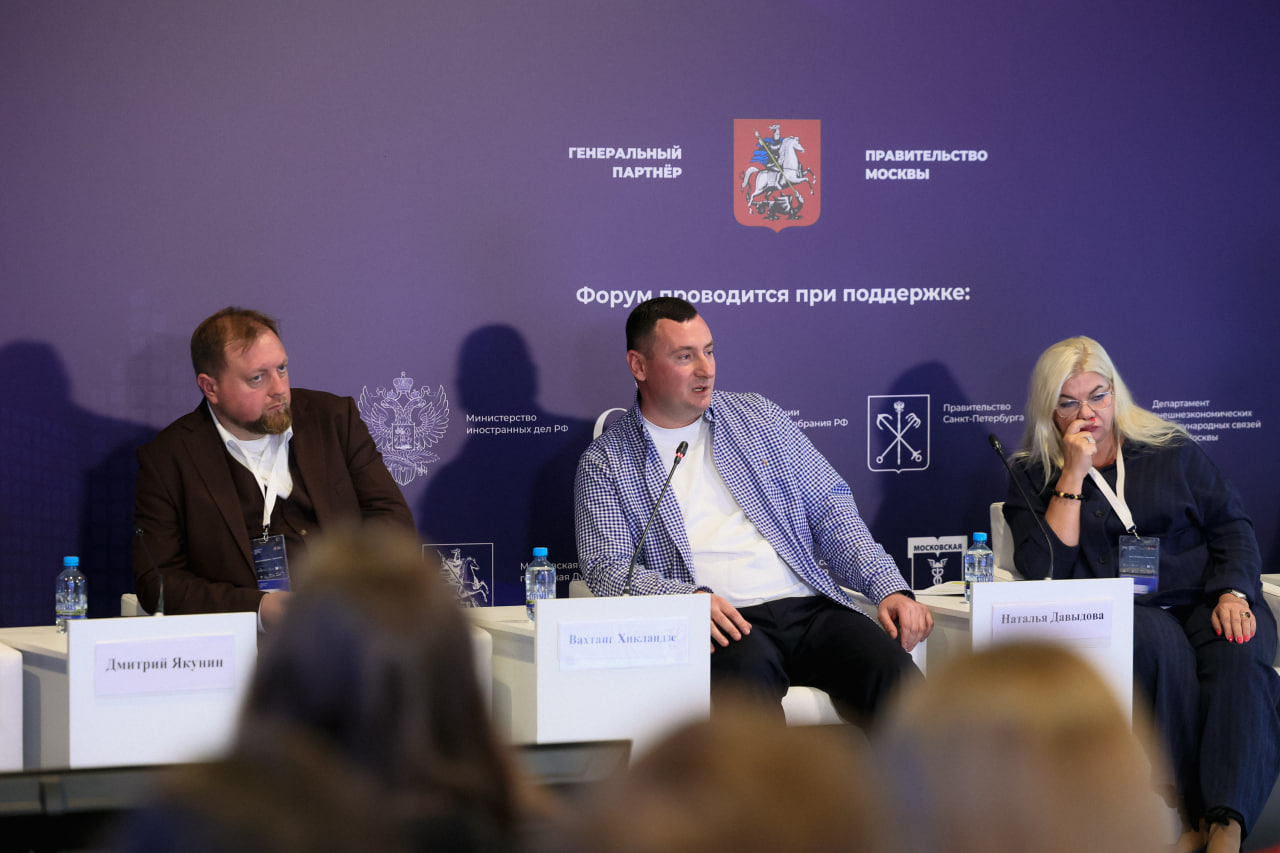
Vakhtang Hiklandze, Deputy Director General for External Communications of the World Youth Festival Directorate, spoke about the key role of creative industries in strengthening international youth cooperation.
"We are purposefully moving the creative industries in a separate, meaningful direction. While preserving the rich cultural program established by the Festival in Sirius, we have supplemented it with a serious business agenda at the WYF Assembly in Nizhny Novgorod. Approximately 300 young professionals from designers to filmmakers, participated in this event. Over the course of four days, they discussed current industry challenges in the format of 13 talk shows, lectures, and workshops. As a result, they developed concepts for art objects for the upcoming festival in Krasnoyarsk in 2026. In addition to festivals, we systematically support young talents through various programs. For example, in June, we held summer schools for musicians and designers at the “Meganom” Academy. In collaboration with the BRICS Youth Association, we also launched an international mentoring program for creative professionals, including AI creators and motion designers. This program allows them to intern at large companies in BRICS countries. We plan to organize a program for at least 1,000 representatives of the creative industries at the International Festival of Youth in Krasnoyarsk and are open to incorporating the most ambitious ideas and formats, said Vakhtang Hiklandze.
The thematic session was attended by Irina Sukholet, Rector of the Institute of Contemporary Art; Elmira Shcherbakova, Chair of the Cultural Commission of the Civic Chamber of the Central Federal District and President of the "Peace and Harmony" Foundation; Dmitry Yakunin, Member of the Board of the Regional Cinema Support Fund and Rector of Moscow University of Finance and Law; Svetlana Zabelina, Deputy of the State Duma of the Federal Assembly of Russia; Tatyana Butskaya, Deputy of the State Duma; Natalia Davydova, Director of Charity Foundation "Under the Flag of Goodness"; Igor Koval, Director of Innovation and Ecosystem Development Department at RWB; Svetlana Kuropatkina, Head of St. Petersburg Capella Centre for Creative Industries; Elizaveta Kholmushina, Finalist of ArtMasters; Alexandra Kholmushina, Graphic Designer.
According to Irina Sukholet, the rector of the Institute of Contemporary Art, today's professionals are hybrids: artists who know technology, designers who can think like business people, and managers who understand the language of art. The university's approach to education is based on the "learning by doing" principle, where students solve real-world problems and see their ideas turn into products. The panelists emphasized the importance of charitable organizations in fostering a culture of engagement and supporting artists. In addition, the experts discussed strategies for successful collaboration between universities and the industry in the creative economy. They also discussed possible measures to promote this partnership and necessary infrastructure solutions for facilitating youth interregional exchanges of experience.
Overview:
The World Youth Festival took place on March 1–7, 2024 in Sirius, according to the Decree of Russian President Vladimir Putin on the development of international youth cooperation. The WYF-2024 brought together 20,000 young leaders from 190 countries.
In accordance with the instructions of the President of the Russian Federation Vladimir Putin on preserving and developing the legacy of the World Youth Festival, which took place on the Sirius Federal Territory in 2024 and united 20,000 young people from 190 countries of the world, festival events on the territory of the Russian Federation will be held annually. The next World Youth Festival for 20,000 participants will be held in 2030. In 2026, there will be a smaller event, an International Youth Festival with 10,000 participants. In between, the World Youth Festival’s themed Assemblies will be held annually for 2,000 participants.
The first World Youth Festival Assembly was held in Nizhny Novgorod from September 17 to 21, 2025 and brought together 2,000 young people from 120 countries. The World Youth Festival Directorate continues the work aimed at strengthening international youth cooperation.